FedPS: Federated Preprocessing for structured data
via aggregated Statistics
TL;DR: A framework for preprocessing tabular data in federated learning.
Why Federated Preprocessing?
Data preprocessing is a crucial step in machine learning pipelines, transforming raw data into a suitable format for model training. However, in federated learning (FL), where data is distributed across multiple clients, the vast majority of research has focused on model training, often neglecting the critical preprocessing phase.
We introduce FedPS, a federated data preprocessing framework that uses aggregated summary statistics from clients to perform core preprocessing tasks, allowing clients to apply consistent transformations without centralizing raw data.
Preprocessing Strategies in FL
Several preprocessing strategies are possible in federated learning:
- Centralized preprocessing: Upload all data to the server.
- No preprocessing: Skip preprocessing entirely.
- Transfer preprocessing: Use public data or pre-trained models.
- Local preprocessing: Each client processes its data independently.
- Federated preprocessing: Use our proposed FedPS framework.
All alternatives except federated preprocessing have major limitations (Table 1).
| Strategies | Key Summary |
|---|---|
|
|
|
|
|
|
|
|
|
|
How Does FedPS Work?
The FedPS framework operates in five steps (Figure 1):
- 1 Compute local statistics;
- 2 Share and aggregate statistics;
- 3 Derive preprocessing parameters;
- 4 Broadcast parameters to clients;
- 5 Apply preprocessing locally.

Case Studies
Example 1: Implementing StandardScaler, which ensures features have zero mean and unit variance.
- 1 Clients compute statistics (n, c=\sum_i x_i, s=\sum_i x_i^2), where n is number of samples.
- 2 Server aggregates these statistics by summation: (N=\sum n, C=\sum c, S=\sum s).
- 3 Server computes the global mean and variance: \mu=C/N, \sigma^2=S/N-\mu^2.
- 4 Server broadcasts parameters (\mu, \sigma) to all clients.
- 5 Clients scale the feature as x'=(x-\mu)/\sigma.
Example 2: Implementing KBinsDiscretizer (quantile), which discretizes continuous features into k bins based on quantiles and ensures that each bin has the same number of samples.
- 1 Clients construct local quantile sketches.
- 2 Server merges sketches to estimate global quantiles.
- 3 Global quantiles are obtained as bin thresholds.
- 4 Server broadcasts thresholds (T_0, T_1, ..., T_k) to all clients.
- 5 Clients assign x to bin j if T_j \le x < T_{j+1}.
What Statistics Are Needed?
We categorize preprocessing tasks into five types:
- Scaling: Normalize features to comparable ranges.
- Encoding: Convert categorical values into numerical form.
- Transformation: Apply non-linear mappings (distribution adjustments).
- Discretization: Convert continuous values into discrete form.
- Imputation: Fill in missing values (univariate or multivariate).
We then examine the summary statistics required by preprocessors in Scikit-learn. Table 2 highlights representative preprocessors and their formulations.
| Categories | Preprocessors | Formulation | Statistics |
|---|---|---|---|
Scaling |
(x-x_{\min})/(x_{\max}-x_{\min}) (x-\mu)/\sigma (x-Q_2)/(Q_3-Q_1) |
Min, Max Mean, Variance Quantile |
|
Encoding |
ordinal(y) one-hot(x) ordinal(x) |
Set Union Set Union, Frequent items Set Union, Frequent items |
|
Transformation |
\psi(\lambda,x) CDF(x), \Phi^{-1}(CDF(x)) |
Sum, Mean, Variance Quantile |
|
| Discretization | j if T_j\le x<T_{j+1} | Min, Max, Quantile, Mean | |
Imputation |
mean(x), median(x), freq(x) mean(k-NN of x) RegressionModel(x) |
Mean, Quantile, Frequent items Min, Mean, Sum Sum |
Basic statistics, Min, Max, Mean, Variance, are inexpensive to compute in a federated setting. In contrast, statistics like quantiles and frequent items require substantial communication if computed exactly. For these, we use data sketching techniques (quantile sketches, frequent-items sketches) to compute them.
Some preprocessors rely on machine learning models, for example:
- KBinsDiscretizer (kmeans) uses k-means clustering.
- KNNImputer uses k-nearest neighbors.
- IterativeImputer uses Bayesian linear regression.
We extend these algorithms to the federated setting, with sufficient statistics summarized in Table 2.
Empirical Evaluations
We evaluate StandardScaler using federated, local, and no preprocessing strategies on the Cover dataset. We train using the FedAvg algorithm and an MLP model. Test accuracy results are shown in Figure 2. We consider both IID and non-IID settings:
- IID setting: data is uniformly at random partitioned across clients.
- Non-IID setting: data is partitioned with skewed label and feature distributions.
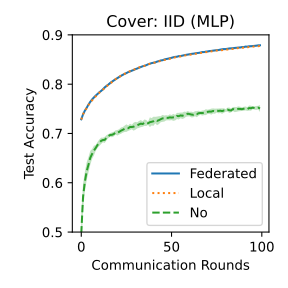
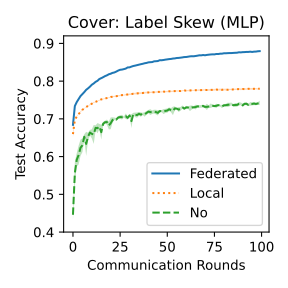
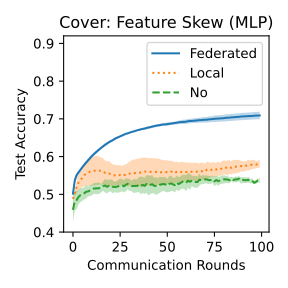
The results highlight three key observations:
- Preprocessing substantially improves accuracy compared with no preprocessing.
- Local preprocessing performs poorly in non-IID settings due to inconsistent transforms.
- Federated preprocessing achieves the most stable and highest performance.
Takeaway: Federated learning pipelines should incorporate data preprocessing as well as model training.
Citation
@article{Xu2026fedps,
  author = {Xu, Xuefeng and Cormode, Graham},
  title = {FedPS: {Federated} {Preprocessing} {for structured data via
    aggregated} {Statistics}},
  journal = {Transactions on Machine Learning Research},
  date = {2026-09-24},
  url = {https://openreview.net/forum?id=MdeXZVjNKu},
  langid = {en}
}